“Why do we own bonds?” Investor in 2013
“Why don’t we own more bonds?” Same investors, now
The sharp equity market declines in recent weeks have once again confirmed that fixed income remains the ballast and primary diversifier of a portfolio. Investors should expect that when other asset classes are experiencing losses, fixed income investments will remain resilient and mitigate a portfolio’s overall decline. For most investors, fixed income will always remain a meaningful piece of the overall portfolio. As part of that fixed income allocation, unconstrained fixed income strategies are growing in demand. From the September/October 2014 IMCA Journal:
Morningstar’s nontraditional bond fund category, which contains the majority of funds classified as unconstrained, grew from $20 billion in total assets in January 2010 to $119 billion in total assets as of November 2013.
At Dorsey Wright, we believe that this category of unconstrained bond strategies will continue to become more important to investors in the years ahead. In March of 2013, we introduced our “Tactical Fixed Income” separately managed account and we have been very happy with the results since inception. Performance and holdings are shown below:
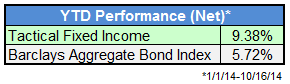

For more information about this strategy, pleas see the FAQ’s below:
Why is there a need for Tactical Fixed Income?
Bond buyers face a dilemma. Yields are very, very low (and have recently been going even lower). If interest rates stay low this low, bondholders are facing minimal returns, all the while having those returns eaten away by inflation. If interest rates rise, bondholders are facing potentially significant capital losses. Both outcomes, obviously, are problematic. This situation demands a tactical solution that can manage through either outcome.
At Dorsey Wright, we have taken our time-tested relative strength tools and have applied them in a unique way to the fixed income markets. This solution is now available as a separately managed account. We think it will be welcome news for bond holders and prospective bond buyers who are grappling with the current bond market dilemma. Equally important, we think it will be a robust solution in the future across a broad range of possible interest rate environments.
What is the investment universe for the Tactical Fixed Income strategy?
The Tactical Fixed Income strategy can invest in short-term and long-term U.S. Treasurys, inflation-protected bonds, corporate, convertible, high yield, and international bonds. This is a broad universe of fixed income types that have varying yields and volatility characteristics.
How is the risk managed in the Tactical Fixed Income portfolio?
The Tactical Fixed Income model structures the portfolio in a way that balances risk and reward. Certain types of fixed income behave better in “risk-on” environments, while other fixed income categories are more defensive. Our model is built to ensure that the portfolio remains diversified. It’s very important to understand that this is designed as core fixed income exposure. We’re trying to generate good fixed income returns, without creating equity-like volatility.
Our model compares the relative strength of all of the ETFs in the investment universe. Those fixed income sectors exhibiting the strongest trends will be represented in the portfolio.
How does the strategy handle a rising rate environment?
Although the general trend of interest rates has been down over the past three decades, there have been periods where rates have generally risen. The period of mid-2003 to mid-2007 was generally a period of rising interest rates, while the period of mid-2007 to present has generally been a period of declining interest rates. Sectors like long term government bonds tend to perform much better in a declining interest rate environment while sectors like convertible bonds tend to perform much better during rising rate environments.
Our Tactical Fixed Income strategy is designed to be adaptive and seeks to add value in both environments.
Will the strategy invest in inverse bond ETFs?
We do not use inverse bond ETFs in the portfolio due to the cost of carrying the short positions, which includes the management fees of the ETFs as well as paying out the interest payments while you own these funds. However, a rising rate environment typically is accompanied by a strong economy. We do have ample ability to have exposure to sectors of the fixed income market, like high yield, international, and convertible bonds, that may perform well during these environments.
What is the turnover of the Tactical Fixed Income strategy?
Adapting to different fixed income environments is the nature of the Tactical Fixed Income strategy. We built the strategy to be robust across the spectrum of bond market environments. The model typically has about twenty swaps a year. Our model selects approximately six ETFs to be held in the portfolio and each position remains in the portfolio only as long as it retains strong relative strength. We have a disciplined relative strength process in place to replace any positions that weaken beyond an acceptable level.
To receive the fact sheet for this portfolio please e-mail [email protected] or call 626-535-0630.
Net performance shown is total return net of management fees for all Dorsey, Wright & Associates accounts, managed for each complete quarter for each objective. The advisory fees are described in Part II of the adviser’s Form ADV. All returns since inception of actual Accounts are compared against the Barclays Aggregate Bond Index. A list of all holdings over the past 12 months is available upon request. The performance information is based on data supplied by the Manager or from statistical services, reports, or other sources which the Manager believes are reliable. There are risks inherent in international investments, which may make such investments unsuitable for certain clients. These include, for example, economic, political, currency exchange, rate fluctuations, and limited availability of information on international securities. Past performance does not guarantee future results. In all securities trading, there is a potential for loss as well as profit. It should not be assumed that recommendations made in the future will be profitable or will equal the performance as shown. Investors should have long-term financial objectives when working with Dorsey, Wright & Associates.